
From Niigata Prefecture's Ichishima Shuzo, this is a subtly unusual offering. The alcohol-added honjozo category, already relatively rare in the U.S., and in the generally uncommon tokubetsu version. Was this a ginjo in a former liftime? At any rate, this appears to be new to our shores, and I was very much looking forward to trying this. And, not at all disappointed. Gohyakumangoku and koshibuki milled to 60%, a solid sake meter value of +8, and allegedly made from snowmelt waters. Delivers a clean, light, and dry taste, easy drinking session sake.

 This sake was sent to us recently by a friend who lives in Tokyo, it's one of the "gold medal" winners at the BY23 (this year) national sake evaluation. Ok, so 286 out of 1085 entries won a gold medal, but these competition sake are the cream of the crop, for the entire country. Nihonbashi Daiginjo (can't read the main kanji - anyone care to illuminate?), by Saitama Prefecture's Yokota Shuzo. 100% Yamada Nishiki, semaibuai 40%, SMV +5, acidity 1.3. TREMENDOUS ginjo nose, smooth, clean sweetness. Doesn't taste as dry as the numbers suggest, silky goodness. Yum!
 Jun Daiti, from Brasil. The only details I can find is that it's got 13% alcohol, which tastes several percentage points low. In a bad way. My understanding is that this is actually based on the Gekkeikan USA product, and also listed with Diageo! Not much information to be found out there about this, but just as well, there's nothing particularly redeeming here, other than, depending on your point of view, the "design" (because, a search for "jun daiti" pulls up lots of similar looking/sounding design blogs.) And, skimming off the top too - a 670ml bottle! That is no multiple of gō!
 What to do with excess Brasilian sake, particularly if you don't want to drink any more of it? I will be following up on a suggestion to use it for braising, but seeing as I had a fair amount to get through, I thought I'd attempt to improve upon the listless/lifeless versions I tried in Brasil. I'll say that this wasn't much of an improvement... as then, it tasted of most of the ingredients: lime, mint, & kiwi, muddled and mashed with my pilão, topped with Azuma Kirin over crushed ice. Couldn't really much make out the sake, not that I really wanted to taste this sake anymore, but I don't see how you could over all the other stuff... maybe needs a very strongly rice-y sake?
 From Brasil's


 Continuing on this particular odyssey, a huge can of sake, half a litre of Kikusui Funaguchi Ichiban Shibori Honzojo Nama Genshu - I quite like this sake, the ultimate winter warmer, but this is a lot of firepower!
 Liquor Mountain in Fushimi, where we picked up a pair of 20% nama genshu, for breakfast.
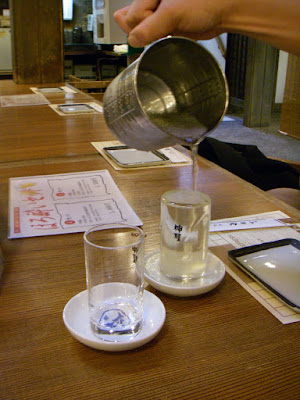 Back to Torisei in Fushimi for more of the delightful ginjo nama genshu.
 So, they keep the tank of sake right out in the middle of the restaurant, but I'd not seen them top up the tank before. Only wish they'd pick a nicer bucket, rather than the kind that one finds in Asian toilets.
 Having gone for a quick dip in Arashiyama (ok, ok, I fell in), warmed up with some familiar convenience-store purchases: Tama no Hikari Junmai Ginjo and Shirataki Mizunogotoshi Junmai. Standard fare, the former being true to Fushimi-style, soft and neutral, and the latter being slightly unusual Niigata fare, soft and slightly round, but still clean.
 Back to Nichi-an. My first Jokigen, a ginjo yamahai genshu, yamada nishiki milled to 55%, SMV +6, acidity 1.4, amino acidity 1.2, and 16.5% alcohol, which seems particularly low for a genshu. Not that I could tell that it was yamahai, genshu, and not junmai. Very tasty and balanced.
 Ebi-san at Nichi-an. I really would appreciate if someone could tell me what the one on the right is... "Etsugaijin?" But not that gaijin. On the right though, my first Furosen, a Yamahai Junmai Daiginjo - one of the very, very few breweries that don't use any cultured yeasts. Graceful with richness and umami, but certainly not wild.
 Another first for me, Jyuyondai Tatsuno Otoshigo Junmai Nama - the tatsuno otoshigo (seahorse) is the name of the rice varietal. Soothing and pretty gentle, but what a price! ¥3400 for the 720ml bottle.
  Having tired of walking, we took a day trip to Amanohashidate. The train, as ever, is an opportunity to drink sake. Another of Fushimi's own, Tomio Junmai Ginjo Hiyaoroshi, which was full of fall feeling, just plumped up and savoury enough.
  Back to Kyoto, Daimon-san at Mukune had recommended that we visit the sake bar Yoramu, which is run by an Israeli guy. I can't help but feel we'd have had a better experience if we were actually Japanese, which is a strange twist, but I'll leave that alone and just comment on the sake. The focus here is on unpasteurised sake, and aged sake, much of it aged by the owner with a strict foreswearing of temperature control. Given that most producers are reluctant to ship namazake abroad because of a) lack of temperature control and b) shipping time affects freshness, here is a shop on the far side of the spectrum. Above, Kidoizumi Junmai Nama Genshu, an organic producer from Chiba, one of the prefectures I missed on my
  (L) Kariho Yamahai, apparently not the Namahage, and aged by the proprietor for 10 years, in his hall closet. It was surprisingly mellow, not raging and mad like the Namahage, with only a mild sourness giving nod to the method. (M)Joho - not sure of the brewing details, except that although this sake was bottled in 2008 (20BY), it was actually aged, warm, by the brewery for 8 years before that. Again, unexpectedly mellow, only the earliest hints of madeirization. (R) A mystery producer, but lots of details - junmai muroka, gohyakumangoku rice milled only to 80%, SMV +8, acidity 2.7, 19.5% abv (genshu?), and aged for 4 years before bottling last year. The "wildest" of the group, but primarily for the acidity.
 (L) Another organic producer, from Kochi, Mutemuka (no hand, no crown) Junmai Nama. Aged by the producer for 6 months at room temperature, resulting in a biggish but dry sake with a particularly earthy and ricy finish. (M) The same Terada Honke as earlier at Umi (oho, not so unique are we, Mr. Yoramu?). (R) Maibijin Yamahai Junmai, truly a "dancing beauty."
 Back to Nichi-an, for dinner and more sake. Unfortunately, at precisely this moment, my back legs failed and I have no recollection whatsoever of the producer. As you can see, the label is of no help in this matter, but what it is is a "single-paddy-field" sake. We tried two, this 611, and another, the 437. They struck me as being particularly fragrant and fruity, a bit like dewasansan rice. I wish I could remember the brewer's name!
 Next day, back legs recovered, a less-exalted lunch along the river in Arashiyama, with this "shibotasonomama", a variation on "just pressed" that I've not seen before this trip (but now seeing everywhere.)
 Being the friendly sorts we are, we invited some passing-by kayakers for a drink, and they heartily accepted (and approved of our selections.)
 And finally, the last sake selections of the trip. (L) Suigei Junmai from Kochi Pefecture. Love the name, "drunken whale", and the sake is lovely and dry, and this is no exception. I prefer this one though, made from Hattan Nishiki, to the tokubetsu junmai made from Matsuyama Mitsui - not sure why, just not keen on the latter's anise notes. (R)Bijofu Junmai Usu-nigori, not only just lightly filtered, but bottled with the intent of allowing continuing fermentation, and thus, a lightly sparkling, but thoroughly dry sake. Not as tasty as Mukune's usu-nigori, but probably the tastiest sparkling sake I've tried.
 Another excellent trip to Japan, 11 days in and about Kyoto. Heavily focused on sake-education. Exhibit 1 is the menu from Umi in Pontochō, a place that seems to be more sake bar than izakaya
 As with all exercises, it is important to warm up properly, so, to another "Umi", also in Pontochō. My eyes trained immediately on a namazake from Denshu.
 From Umi to shining Umi, as the song goes. Note the exquisitely prepped and dried fishies.
 On the left, Kirei Junmai Karakuchi Hachiju from Hiroshima - unusual in that the rice here is only milled to 80%, reflecting the new rules for junmai. A full on 17.5%, and a proper departure from Hiroshima's soft sweet style, which the owner attributed to the water the brewery uses. Maybe not as "pretty" as the name suggests (a play on words actually, as the kanji refers to the age of a turtle), but a tastily forward sake.
 Unfortunately, I can't decipher the junmai ginjo on the right, but the Yamagata sake on the left is no secret. Or, rather, it is, "Naishyo" Hiyaoroshi Junmai Nama Genshu, which was as brash as might be expected from this combination, and also rather earthy.
 We made a lunchtime visit to
  20 year-old koshu in Yamamoto-Honke's chicken-focused pub, Torisei, in Fushimi. If anyone wants to try chicken sashimi, this is the place. Haunting is not the right word for this sake though. Disturbing is more like it. Certainly madeirized, but maybe more in common with marmite and shoyu than sake. My man G. was complaining about the aftertaste days later. Still, given that their ginjo nama genshu is so good, and this is certainly out there on the fringes, I don't understand why their onigoroshi is so pedestrian (and more so, why they have to send it to the U.S.)
 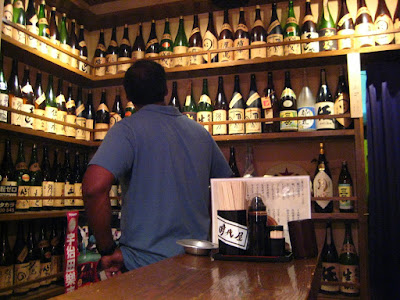 Mukune-interns
  I might be wrong, but I think this junmai ginjo was from Matsumoto Shuzo in Fushimi, Nokomi?
 At any rate, when it came time to pay and leave, G. was offered a job. If only. I love this place.
 Certainly looking the part.
 Irrashai!!!! Of course, G. made a proper hash of it, scaring the locals. Not ready for Captain Fantastic and the Brown Cowboys, it appears.
 Another bash at Umi in Pontochō. (L) Terada Honke Junmai Nama. This brewery is truly out there - all organic, brewing 100% in the kimoto style, and additionally, with no cultured yeasts added at all. Can't argue with their belief in the Japanese proverb Hyakuyaku no Cho ("sake is healthier than 100 medicines.") Milled only to 90%, and unusual. Sour and earthy, this is not tanrei. (C) I may have misunderstood this one, because I thought the proprietor said Kaiun, which I know, but he said that it Kaishun. Never heard of it. On Junmai Nama, and, again, if I've understood correctly, fermented in wood vats. More familiar than the Terada Honke, but still with that pronounced earthy sharpness. (R) Kitajima Tokubetsu Junmai Kimoto Nama Genshu, easily the cleanest of the bunch, but also the most powerful, and a sort of tame nama, so a bit dangerous!
 They just kept rolling out. The Terada on the left, but now the (C)Daishichi Junmai Kimoto Nama Genshu, which I know and love, and the (R) Naishyo from the previous visit.
 And finally, a doburoku style sake made by Nara Prefecture's Okura Honke. I noticed this in some restaurants in Nara as well, which I found a bit surprising, given this sake, brewed in a 600-year-old style, was more of a dry alcoholic cross between rice pudding and a vanilla milkshake, complete with a sprinkling of cinnamon. This, sadly, was the closest I would get to Shirakawago's Doburoku festival, held while we were in Japan, but ultimately far too difficult to get to (and no accommodation to be had for miles.)
 Speaking of Nara, there was a small fair outside Todaiji in Nara Koen, with this stand of local sake, including, of course, Harushika, Ume no Yado, and my favorite Mushohai.
 My favorite sake shop in Nara. I still don't know the name, but I know how to find it. Or, at least I always end up there.
 And, on the way back to Kyoto, some refreshments for the train, three Nara cup sake.


 To top off a day in the Twin Cities, a visit to
  It appears that there are about 7 regular brews at moto-i, as well as some seasonal batches, all brewed on site (starters in the foreground, main mash behind.) Koji rice is cultivated in a room upstairs. Though I didn't see the machine, we learned that some of the sake is pressed by Yabuta, while others are done with the manual fukurotsuri method, where mash is packed into canvas bags, hung, and allowed to drip free.
 (clockwise from top left)
 And there you are. Proof again that it is possible to brew decent sake outside Japan (as long as it is brewed with Nordic influence, right?) Perhaps overall a bit sweeter than I like, and the nama-chozoing, for me, well, I'd have preferred to taste it fresh, but really an all-round good effort. The regular Junmai Ginjo Nama was not available, nor were the Junmai Kimoto Nama (the curious omission of yeast information suggesting this is 100% wild!) or the Futsuu Tokubetsu (not really sure what this could possibly mean), so I guess we have to go back.


 Posts
Posts

