
One more souvenir from Osaka Prefecture's Mukune, a singly-pasteurised brew, and the first batch of fall-release sake. Gohyakumangoku and Nihonbare milled to 60%, SMV +3, acidity 1.6, 17.5% abv. Floral nose with darker wood and sour roast rice notes. Moderately big and round on the entry, caramel and wood spice on the mid, followed by sharp acidity and assertively dry finish. This is all transitional, bold and lovely for a cool autumn evening.


 Another excellent trip to Japan, 11 days in and about Kyoto. Heavily focused on sake-education. Exhibit 1 is the menu from Umi in Pontochō, a place that seems to be more sake bar than izakaya
 As with all exercises, it is important to warm up properly, so, to another "Umi", also in Pontochō. My eyes trained immediately on a namazake from Denshu.
 From Umi to shining Umi, as the song goes. Note the exquisitely prepped and dried fishies.
 On the left, Kirei Junmai Karakuchi Hachiju from Hiroshima - unusual in that the rice here is only milled to 80%, reflecting the new rules for junmai. A full on 17.5%, and a proper departure from Hiroshima's soft sweet style, which the owner attributed to the water the brewery uses. Maybe not as "pretty" as the name suggests (a play on words actually, as the kanji refers to the age of a turtle), but a tastily forward sake.
 Unfortunately, I can't decipher the junmai ginjo on the right, but the Yamagata sake on the left is no secret. Or, rather, it is, "Naishyo" Hiyaoroshi Junmai Nama Genshu, which was as brash as might be expected from this combination, and also rather earthy.
 We made a lunchtime visit to
  20 year-old koshu in Yamamoto-Honke's chicken-focused pub, Torisei, in Fushimi. If anyone wants to try chicken sashimi, this is the place. Haunting is not the right word for this sake though. Disturbing is more like it. Certainly madeirized, but maybe more in common with marmite and shoyu than sake. My man G. was complaining about the aftertaste days later. Still, given that their ginjo nama genshu is so good, and this is certainly out there on the fringes, I don't understand why their onigoroshi is so pedestrian (and more so, why they have to send it to the U.S.)
  Mukune-interns
  I might be wrong, but I think this junmai ginjo was from Matsumoto Shuzo in Fushimi, Nokomi?
 At any rate, when it came time to pay and leave, G. was offered a job. If only. I love this place.
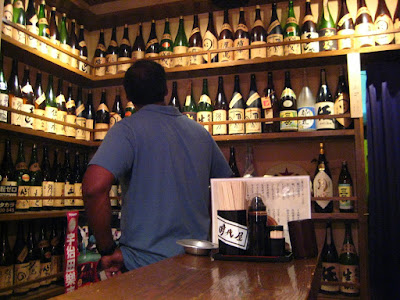
 Certainly looking the part.
 Irrashai!!!! Of course, G. made a proper hash of it, scaring the locals. Not ready for Captain Fantastic and the Brown Cowboys, it appears.
 Another bash at Umi in Pontochō. (L) Terada Honke Junmai Nama. This brewery is truly out there - all organic, brewing 100% in the kimoto style, and additionally, with no cultured yeasts added at all. Can't argue with their belief in the Japanese proverb Hyakuyaku no Cho ("sake is healthier than 100 medicines.") Milled only to 90%, and unusual. Sour and earthy, this is not tanrei. (C) I may have misunderstood this one, because I thought the proprietor said Kaiun, which I know, but he said that it Kaishun. Never heard of it. On Junmai Nama, and, again, if I've understood correctly, fermented in wood vats. More familiar than the Terada Honke, but still with that pronounced earthy sharpness. (R) Kitajima Tokubetsu Junmai Kimoto Nama Genshu, easily the cleanest of the bunch, but also the most powerful, and a sort of tame nama, so a bit dangerous!
 They just kept rolling out. The Terada on the left, but now the (C)Daishichi Junmai Kimoto Nama Genshu, which I know and love, and the (R) Naishyo from the previous visit.
 And finally, a doburoku style sake made by Nara Prefecture's Okura Honke. I noticed this in some restaurants in Nara as well, which I found a bit surprising, given this sake, brewed in a 600-year-old style, was more of a dry alcoholic cross between rice pudding and a vanilla milkshake, complete with a sprinkling of cinnamon. This, sadly, was the closest I would get to Shirakawago's Doburoku festival, held while we were in Japan, but ultimately far too difficult to get to (and no accommodation to be had for miles.)
 Speaking of Nara, there was a small fair outside Todaiji in Nara Koen, with this stand of local sake, including, of course, Harushika, Ume no Yado, and my favorite Mushohai.
 My favorite sake shop in Nara. I still don't know the name, but I know how to find it. Or, at least I always end up there.
 And, on the way back to Kyoto, some refreshments for the train, three Nara cup sake.


 Posts
Posts

